
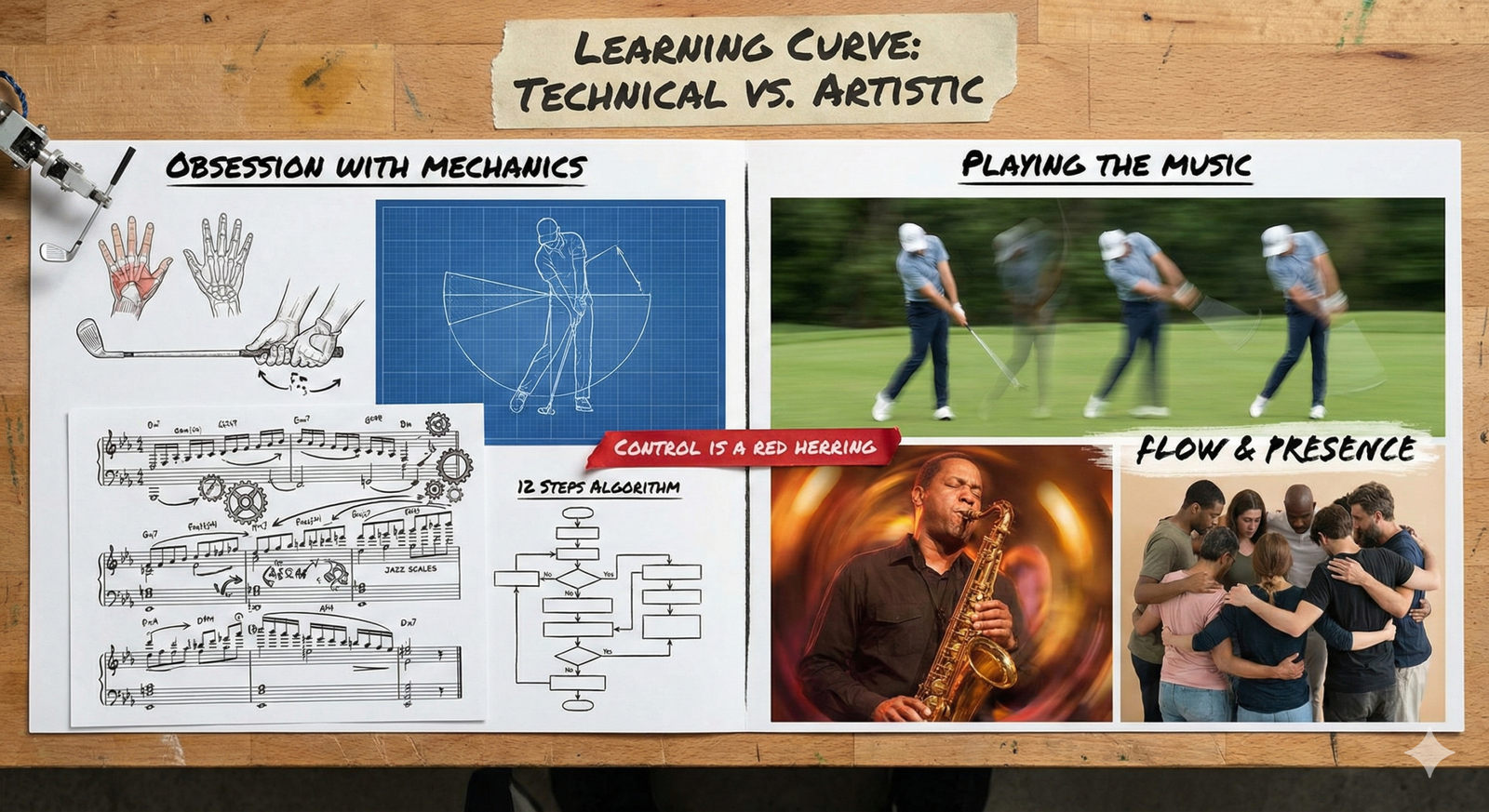
In the early stages of learning a craft—whether it’s a golf swing, a jazz scales, or a life in recovery—we are obsessed with technical proficiency (spoiler: that’s the red herring of control). We want to know exactly where the hands go. We want to understand the physics of the clubface. We want to memorize the “12 Steps” like they’re a math equation. And for a while, this focus serves us. It gives us a sense of control. We think that if we can just master the mechanics, we can master the outcome, not succumb to the red herring of control.
But here’s the secret they don’t tell you at the driving range or in the practice room: technical proficiency is just the foundation. Yes, you need it to get into the building. But if you stay obsessed with the mechanics, you’ll never actually play the music. You’ll just be a robot with a decent handicap – that is truly the red herring of control.
The Trap of the “Perfect Swing” and the Red Herring of Control
We’ve all seen the golfer who has a “technically perfect” swing but can’t score to save his life. They’ve spent thousands of hours on the range perfecting plane and rotation. He has total control over his body. But the moment he gets on the course and the wind picks up, or he has to play a shot from a weird lie, he falls apart.
Why? Because he’s trying to control the game rather than play it.
Technical proficiency is a safety blanket. It feels good because it’s measurable. But it often hinders further achievement because it creates a ceiling. When you are focused solely on “doing it right,” you are rigid. You are playing against the course instead of with it. You’ve mastered the “how,” but you’ve missed the “rhythm.”
Musicality and the Leap of Faith
Now, think about a great band. To reach the level of musicality, every musician on that stage must have technical proficiency. They have to know their scales. They have to know the chords.
But to truly excel—to reach that “Zenith” where the music becomes something transcendent—they have to let go of control. Musicality requires trust and faith. You have to trust your fellow musicians. You have to listen more than you play. You have to allow for the possibility that the drummer is going to take the rhythm somewhere you didn’t expect, and you have to have the “musicality” to follow him there. Or here.
If everyone on stage is just focused on their own technical perfection, the music is dead. It’s only when they surrender the need to be “in control” and start trusting the group that the magic happens.
The Rhythm of Recovery
This is exactly where we find the intersection of the fairway and sobriety.
When I first got sober, I was a “technical proficiency” addict. I counted every minute. I followed every rule to the letter. I was terrified that if I let go of the “controls” for even a second, I’d crash. This gave me a sense of safety, but it didn’t give me a life. I was sober, but I wasn’t living. I was hitting the notes, but there was no music.
Real recovery—the kind that lasts—is about musicality. It’s about the realization that you cannot control your life into submission. You have to have the “technical proficiency” of your daily habits (the meetings, the honesty, the routine), but to truly excel, you have to let go. You have to have faith in your “fellow musicians”—your support system, your family, your community.
You have to trust that if you stop trying to white-knuckle every outcome, the “rhythm” of a good life will carry you.
The Skull & Bogeys Approach
At Skull & Bogeys, we design gear for the guy who understands this balance.
The Skull is the technical reality—the memento mori that reminds us of the stakes. The Bogey is the musicality—the acceptance that the round won’t be perfect, but we’re going to play it anyway.
Our Zenith Mock Neck is engineered for this exact mindset. It provides the “Technical Architecture” you need—the moisture-wicking, the four-way stretch, the structured fit—so that you don’t have to think about your clothes. It handles the “proficiency” so you can focus on the “music.”
When you stop obsessing over the “control” of your swing and start trusting your “feel,” you’ll find that the game (and your life) opens up in ways you never thought possible.
Stop trying to be perfect. Start trying to be in tune. The music is better that way.
Master the mechanics. Trust the music. Shop the Zenith Collection at skullandbogeys.com.