
Why We Need the Bad Round
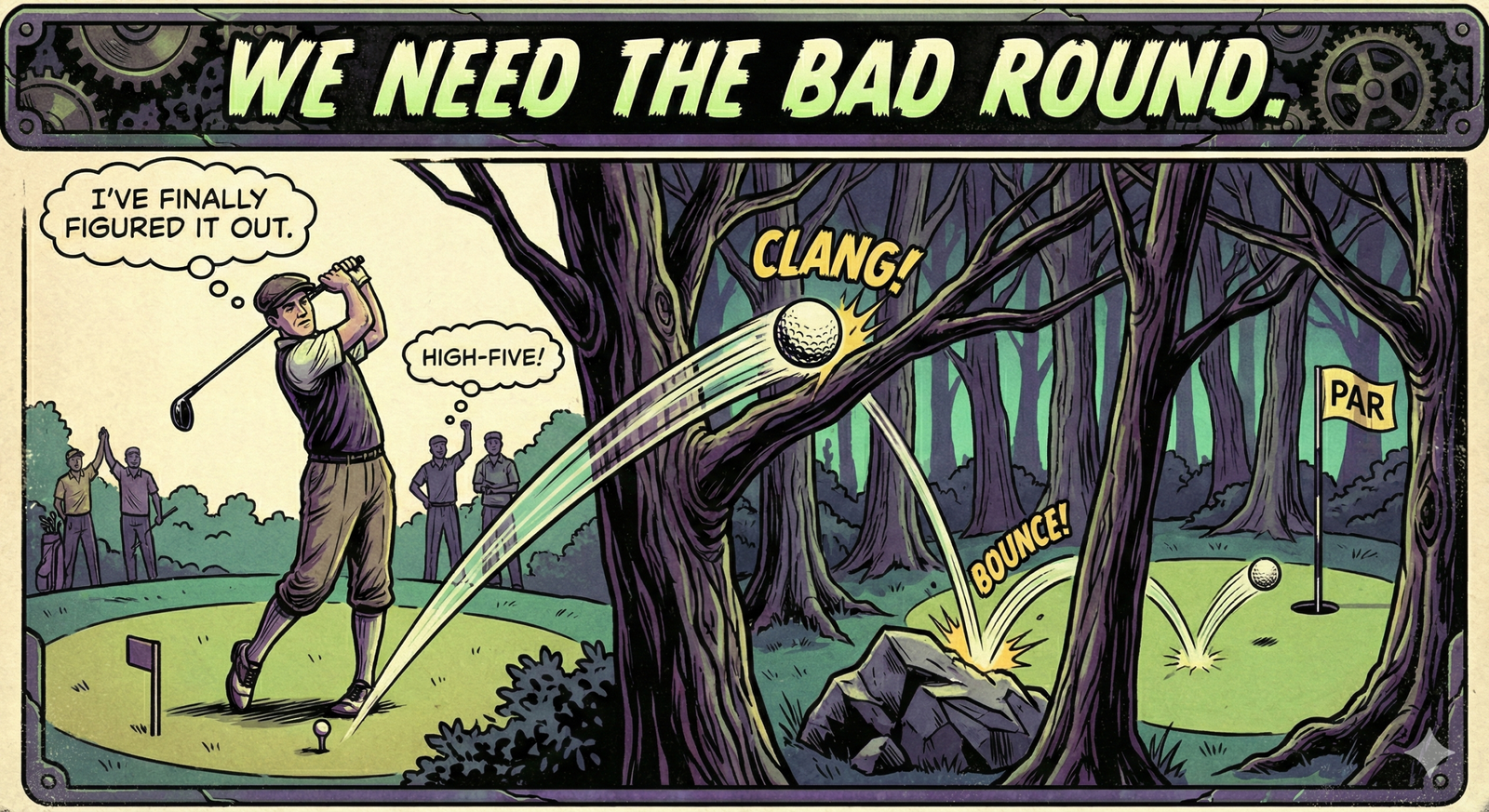
Every golfer has that one “miracle” shot. You slice the ball toward a dense forest, it hits a branch, bounces off a rock, and somehow rolls onto the fringe of the green. You save par. You high-five your buddies. You think, “I’ve finally figured it out.”
In recovery, we call this the “Pink Cloud.” It’s that early stage where the cravings have subsided, your family is talking to you again, and you feel like you’ve conquered the mountain. You’re hitting flukes and calling them skill.
But here’s the problem with the fluke: It doesn’t teach you a damn thing.
The fluke hides your flaws. It rewards bad form. It makes you think you’re better than you are, which is the most dangerous place an addict—or a golfer—can be. If you want to actually get better, you don’t need the miracle bounce. You need the “Bad Round.”
The Diagnostic Power of a Double-Bogey
A bad round of golf is a brutal, honest diagnostic tool. When you can’t find a fairway to save your life and your putter feels like a wet noodle, your true “swing” is exposed.
You see exactly where your mechanics break down under pressure. You realize your grip is too tight, or your tempo is rushed, or you’re pulling your head because you’re scared of the result. The bad round strips away the ego and leaves you with the data.
In my recovery, my “bad rounds” were the days I woke up angry at the world for no reason. They were the days I felt the old pull of the bottle or lashed out at someone I loved. In the past, I would have used those days as an excuse to quit. Now, I see them as a stress test. A bad day in sobriety tells me exactly where my “program” is weak:
- The Grip: Am I trying to control things I can’t?
- The Stance: Am I skipping the fundamentals like sleep, service, or honesty?
- The Focus: Am I looking at the “hazard” of the past instead of the “target” of today?
The “Fluke” vs. The “Work”
At Skull & Bogeys, we don’t worship the hole-in-one. We worship the guy who stays for an extra hour on the range after a terrible round.
The skull on our gear represents the reality that we don’t have time to lie to ourselves. A fluke is a lie. A bad round is a truth. When you have a bad day—on the course or in your head—you are being given a map of what needs to be fixed.
“The man who wins by accident is always one shot away from disaster. The man who learns from his failure is building a game that can’t be broken.”
Respect the Struggle
Most people try to forget their bad rounds. They want to erase them from the scorecard of their memory. But I’m suggesting we do the opposite. We should respect the bad round. * Don’t ignore it: Analyze what went wrong without the “Death Grip” of shame.
- Adjust the mechanics: Use the failure to tweak your approach.
- Get back in the box: The only way to fix a bad round is to start a new one.
Sobriety isn’t about the days when everything goes right. Anyone can be “good” when the sun is out and the wind is down. Sobriety is about how you play the holes when you’re stuck in the trees and the rain is starting to fall.
The Classroom of the Grit
If you’re having a “bad round” in your life right now—if you’re feeling the weight of the struggle or the frustration of a plateau—don’t walk off the course.
The struggle is where the real growth happens. The fluke is a gift, but the failure is a teacher. Listen to it. Learn the lesson. And for God’s sake, keep swinging.
Learn the lesson. Own the grind. Gear for the real players at skullandbogeys.com.